.png)
Brain Mapping and Auditory Neuroscience
From tonotopic maps to clinical rehabilitation of auditory processing deficits
Explore the brain's sensory maps from cochlea to cortex. Gain clinical frameworks for diagnosing and rehabilitating auditory mapping deficits.
$
$
(
$
Course Description
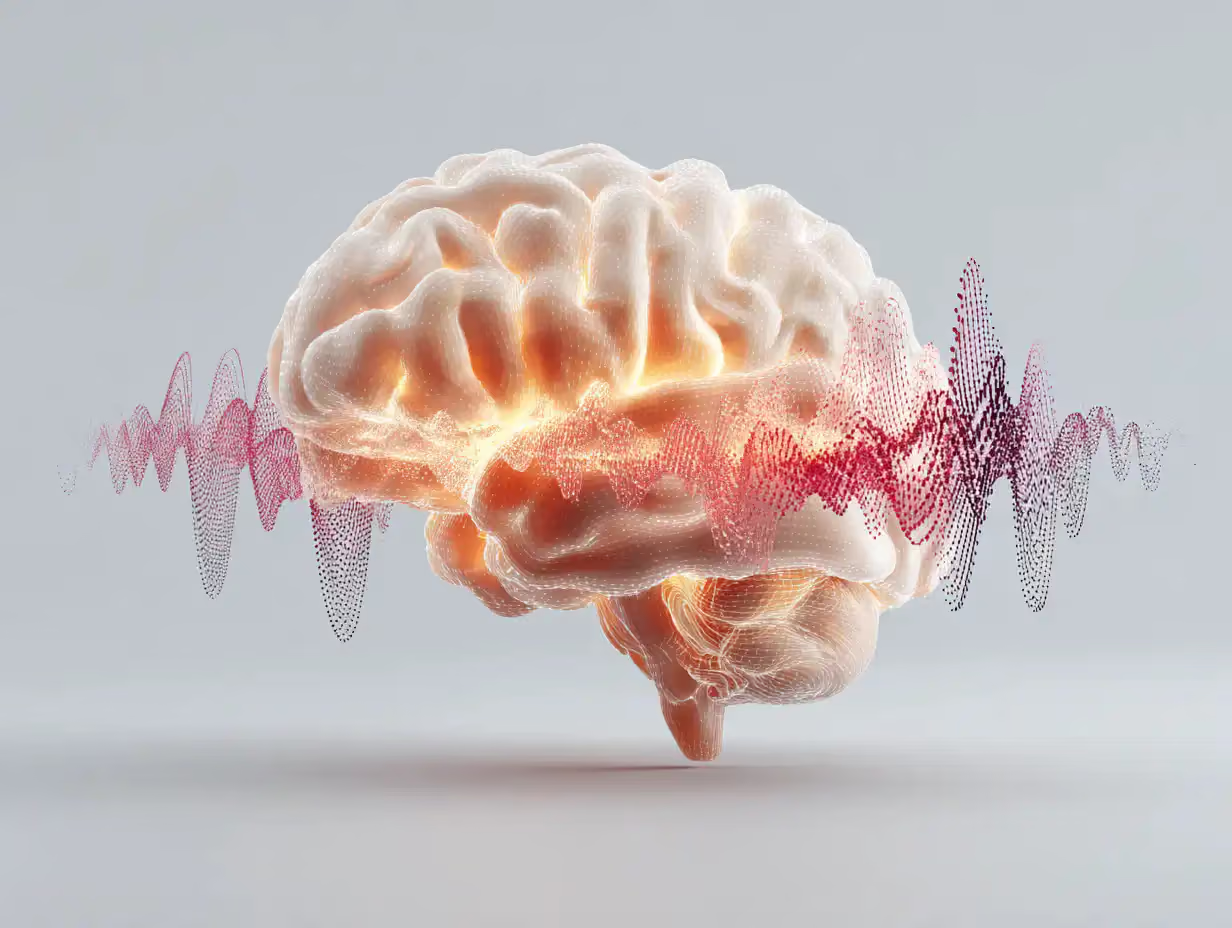
The sensory maps of the brain organize how patients perceive sound, space, and body position. When those maps are disrupted, clinicians encounter patients whose symptoms resist standard explanation: sound sensitivity, poor balance, attention deficits, post-concussion complaints, and chronic dizziness. The gap is rarely the clinician's skill. It is the absence of a systems-level framework that connects peripheral anatomy to cortical function.
This course builds that framework. You will trace the full auditory pathway from the mechanics of the cochlea through the cochlear nuclei, superior olive, inferior colliculus, medial geniculate nucleus, and primary auditory cortex. You will understand tonotopic organization at every relay, apply bedside tools including Rinne and Weber testing, and implement progressive auditory mapping rehabilitation in complex clinical presentations. Designed for licensed clinicians ready to bring precision to auditory and sensory integration cases.
What you’ll learn:
- Trace the full auditory pathway from cochlea to primary auditory cortex
- Interpret tonotopic organization at each relay of the ascending auditory system
- Apply Rinne and Weber testing to localize auditory system lesions
- Distinguish somatotopic, retinotopic, and tonotopic mapping deficits clinically
- Implement progressive auditory map rehabilitation in complex patient cases
More About This Course
The brain does not process sensory information in isolation. It builds maps. Tonotopic maps encode sound frequency across the auditory pathway. Somatotopic maps represent body position across cortical and subcortical structures. Retinotopic maps organize visual space from retina to occipital cortex. These overlapping systems of neural representation are not abstract theory. They are the substrate of clinical presentations clinicians encounter daily: the concussion patient who cannot tolerate background noise, the vestibular patient whose balance collapses in busy environments, the child whose attention fractures the moment the classroom gets loud. Understanding brain mapping at a mechanistic level is what separates pattern recognition from genuine clinical reasoning.
This course, led by Dr. Jonathan Arkin DC, DACNB, provides a rigorous and clinically applied exploration of sensory brain mapping with a primary focus on the tonotopic auditory system. Beginning with the foundational history of cortical mapping from Gall and Brodmann through Jackson and von Bekesy, the course builds systematically through peripheral auditory anatomy, the mechanics of the cochlea and organ of Corti, the ascending auditory pathway through the brainstem, and the tonotopic architecture of the medial geniculate nucleus and primary auditory cortex. Clinicians will examine auditory scene analysis, the cocktail party effect, binaural processing, and the neural mechanisms of sound localization. The course then transitions into clinical application, covering bedside evaluation including Rinne and Weber testing, localization of lesions across the peripheral and central auditory axis, and a practical framework for progressive auditory map rehabilitation in real-world clinical settings.
This training is built for licensed clinicians including chiropractors, physical therapists, occupational therapists, and other qualified healthcare providers who regularly manage complex neurological and sensory presentations. Whether your practice involves vestibular rehabilitation, concussion management, pediatric neurodevelopmental care, or chronic pain and sensory sensitivity, the frameworks presented here will sharpen your clinical thinking and expand your treatment capabilities.
Dr. Jonathan Arkin holds a Doctor of Chiropractic degree and board certification as a Diplomate of the American Chiropractic Neurology Board (DACNB). His training in functional neurology and applied kinesiology informs a teaching style that is both anatomically precise and immediately usable in clinical practice. Clinicians who complete this course will leave with a systems-level model of sensory integration they can apply from the first appointment.
Components
Educational Syllabus
- The Architecture of Sensory Maps in the Brain
- From Brodmann's cytoarchitectural areas to the somatotopic homunculus, this topic builds the conceptual foundation for understanding how the brain encodes and organizes sensory experience across dozens of overlapping maps.
- Peripheral Auditory Anatomy and Cochlear Mechanics
- Explore the precise mechanical cascade from tympanic membrane to basilar membrane tonotopy. Clinicians will understand how hair cell anatomy, ossicular function, and the attenuation reflex govern what the brain actually receives.
- The Ascending Auditory Pathway Decoded
- From cochlear nuclei through the superior olive, inferior colliculus, and medial geniculate nucleus, clinicians gain a relay-by-relay map of auditory processing. Sound localization, bilateral decussation, and tinnitus pathways are all addressed.
- Auditory Cortex and the Complexity of Sound Perception
- Explore tonotopic cortical organization, auditory streaming, the cocktail party effect, and language areas. Clinicians develop a sophisticated model of how the cortex interprets, filters, and assigns meaning to sound in complex environments.
- Diagnosing and Rehabilitating Auditory Map Deficits
- Learn to identify mapping deficiencies across peripheral and central auditory levels, apply systematic rehabilitation from quiet single-target tasks to complex real-world environments. Relevant for concussion, anxiety, balance, and migraine.
Venue, Hotels & Schedule
Also includes

Brain Mapping and Auditory Neuroscience
Explore the brain's sensory maps from cochlea to cortex. Gain clinical frameworks for diagnosing and rehabilitating auditory mapping deficits.
$
$
(
$
The Carrick Institute team is ready to assist with enrollment, CE approval, or program planning. Email visit our CE Portal or Contact Us directly.